Rory Sutherland tells a story about a hotel that replaced its doorman with an automatic door. On paper, it was a clean win. The door opened just as well, never called in sick, and cost nothing after installation.
What the spreadsheet missed was everything else the doorman did. He hailed cabs, remembered regulars, kept the wrong people out, and made the building feel like a place worth paying for. Sutherland calls this the doorman fallacy: you define a job by its most visible task, automate that task, and quietly lose all the value you never thought to measure.
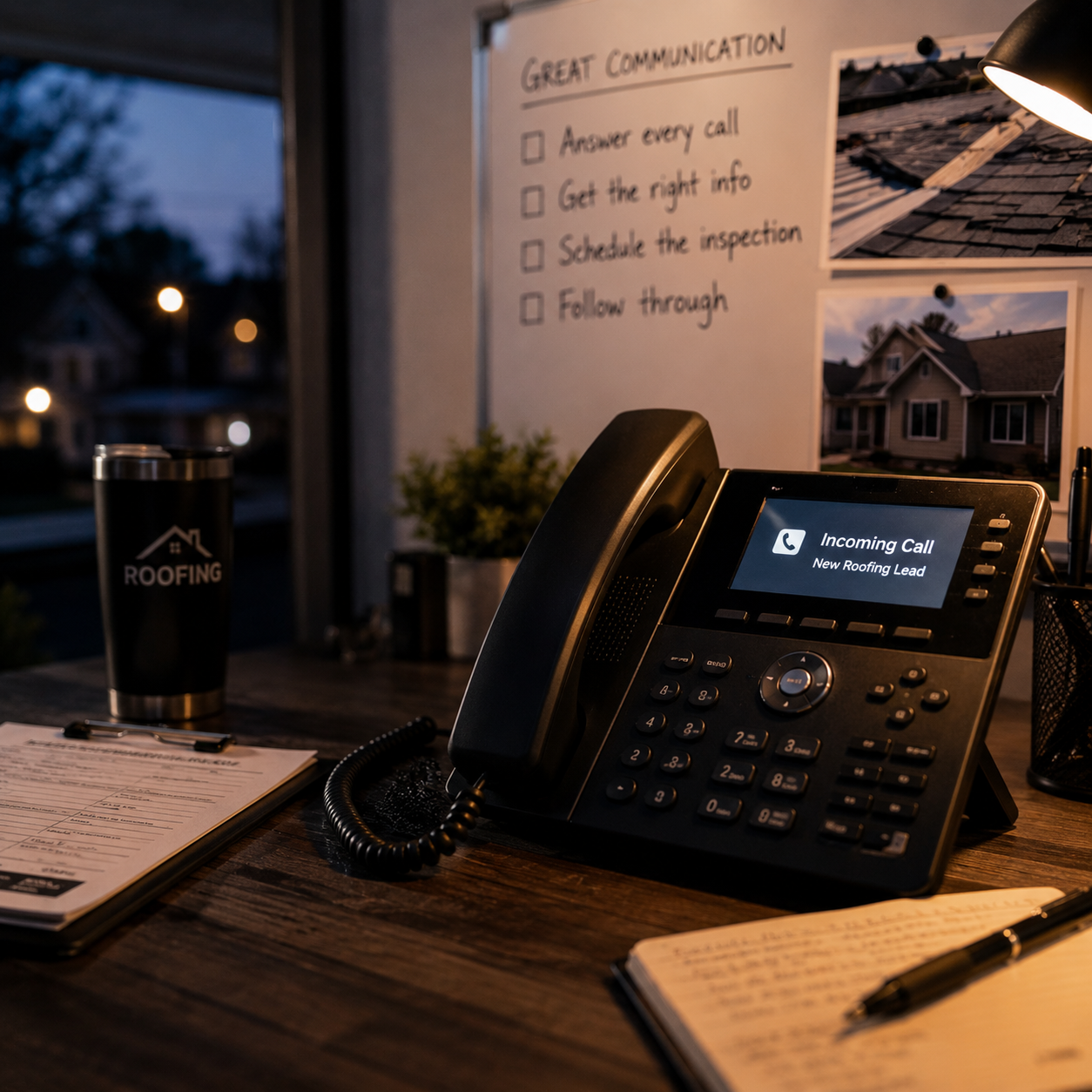
Most bad AI deployments in roofing are the doorman fallacy with a phone number attached. A roofing company decides the job is "answer the phone," buys something that answers the phone, and months later wonders why the calendar looks the same. The AI usually didn't fail. The job description did.
Why AI implementation failure starts before the software does
The most common AI implementation failure I see has nothing to do with the technology. It starts in the buying conversation, when a roofing company frames the purchase as a cost problem instead of a revenue problem.
If the goal is "stop paying for an answering service," then anything that picks up the phone looks like success. Calls answered go up, cost goes down, and the dashboard glows green. Nobody checks whether those answered calls turned into inspections on the calendar.
Here's the part the spreadsheet can't see. The homeowner calling at 9 pm with water coming through the ceiling isn't calling for information. They're calling to find out whether someone competent has their back, and a polite voice that says "someone will reach out tomorrow" feels almost identical to voicemail.
We've written about this before. In The Data Behind Missed Roofing Jobs, we broke down how response time changes booking rates for roofing companies. Leads reached within five minutes booked into appointments 55 to 70 percent of the time, while leads left eight hours or more dropped below 15 percent.
That same breakdown found roughly 35 percent of roofing leads arrive after 5 pm or on weekends. That's exactly when a voicemail or message-taking setup does the most damage.
The AI receptionist problems nobody shows you in the demo
Most articles weighing the pros and cons of AI for contractors get stuck arguing about whether the voice sounds human. That's the wrong fight. The real problems with an AI answering service show up in week three, not in the demo, and almost all of them come from setup rather than the model.
- It answers but doesn't book. If the call ends with a message instead of a time on the calendar, you bought an expensive voicemail with better manners.
- It doesn't know your business. Service area, which jobs you take, how you handle financing, what you say when someone asks for a price over the phone. A generic script gives a generic answer, and homeowners can hear it.
- It can't read the room. AI voice agent limitations are real: the common path goes well; the strange call does not. An angry customer, a supplier on the line, or a situation that needs judgment should reach a person fast, and a lot of setups make that handoff hard.
- It lives outside your CRM. Whether you run AccuLynx, JobNimbus, or something else, the conversation has to land there with notes. Otherwise, your rep walks into the inspection knowing nothing the homeowner already told you.
The biggest of the risks of AI customer service isn't a wrong answer, though. It's a cheap first impression. For a lot of homeowners, that first call is your company, and a voice stuck in a loop tells them exactly how you'll run the job.
Where AI rollouts actually go wrong
Most AI adoption mistakes a small business makes happen after the contract is signed. The demo shows the best call the system will ever take, and nobody asks who will build it around your playbook or how long until it's live on your real phone line.
Then the first 30 days slip by with nobody listening to calls. That month decides whether the agent sounds like your company or like everyone's company, and small mistakes left alone become the permanent script. Meanwhile, your reps, if nobody tells them the AI is there to hand them warmer inspections, quietly ignore the appointments it books.
Underneath all of it is the same error from the top of this piece. Calls answered is the automatic door. Booked inspections, show rate, and closed revenue are the doorman.
When not to use an AI answering service
I'd rather tell you where this doesn't fit, because admitting where a product falls short is the fastest way to learn about where it works. An AI answering service is the wrong first dollar in a few situations.
- Your phone barely rings. If you get a handful of leads a week, you have a marketing problem, not a response problem. Fix the top of the funnel first.
- You only do commercial work. Long bid cycles and relationship-driven sales don't hinge on who picks up at 9 pm.
- Nobody will act on what it books. An appointment no one shows up for is worse than a missed call. If your sales process can't absorb more inspections, fix that before you add more of them.
What a good deployment looks like instead
Pond Roofing didn't need an automatic door. They needed the doorman. They've been putting roofs on homes in Northern Virginia for 62 years, and within the first month of going live in January, marketing director Taylor Carroll watched their booking rate climb from about 20 percent to above 60 percent.
The real test came Memorial Day weekend, when a storm pushed 10 leads in after hours. Their agent, Lilly, answered all 10, and there were 10 appointments on the calendar by Monday morning. Those appointments turned into almost $92,000 in sales. That's the difference between measuring whether the phone was answered and measuring whether the job got done.
What made it work wasn't the voice. Every lead was answered within 90 seconds no matter when it came in, and over a 30 -day review, Lilly followed Pond's own script and playbook 90 percent of the time, against an 85 percent benchmark for their human team. It was built to do their job the way they do it. The full story is in How Pond Roofing Tripled its Booking Rate.
Five questions to ask before you buy an AI answering service
Choosing AI tools for roofing gets easier once you know what to ignore. Most AI receptionist reviews focus on whether it sounds like a real person, so skip those and look for the ones that mention booked appointments, onboarding, and what happened after the first month. Those are reviews of the doorman, not the door.
Then ask every vendor the same five questions:
- Does it book straight onto my calendar, or does it take a message?
- Who builds it around my playbook, and how long until it's live?
- How does a caller reach a real person when they need one?
- Where does the conversation end up in my CRM, and what notes come with it?
- What will we measure together in the first 30 days?
If you want to hear what a properly deployed agent sounds like on real roofing calls, book a demo with Alivo. We typically go live in 14 days, then keep a dedicated onboarding specialist involved for the first 90 days because, as you've probably gathered by now, the software isn't the hard part. The rollout is. And the automatic door was never the point.
About the Author
Matthew Sanborn is a Process Specialist at Alivo, an AI lead engagement platform for roofing and home improvement contractors. His work includes regular conversations with roofing companies evaluating and operating CRM and lead-response systems.